Wheelchair transport
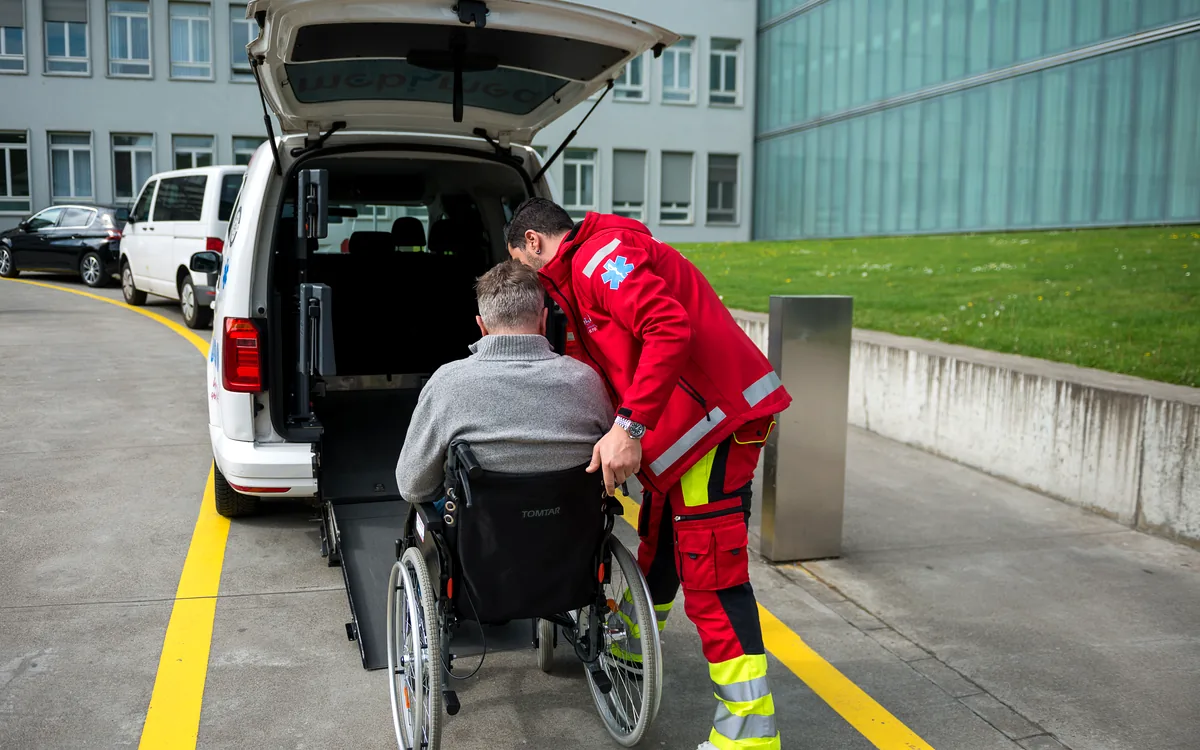
With wheelchair transport, the patient stays seated in their own wheelchair.
Learn more: Wheelchair transport
Glossary · Equipment · also: Four-point restraint system, Wheelchair tie-down, Wheelchair securement system
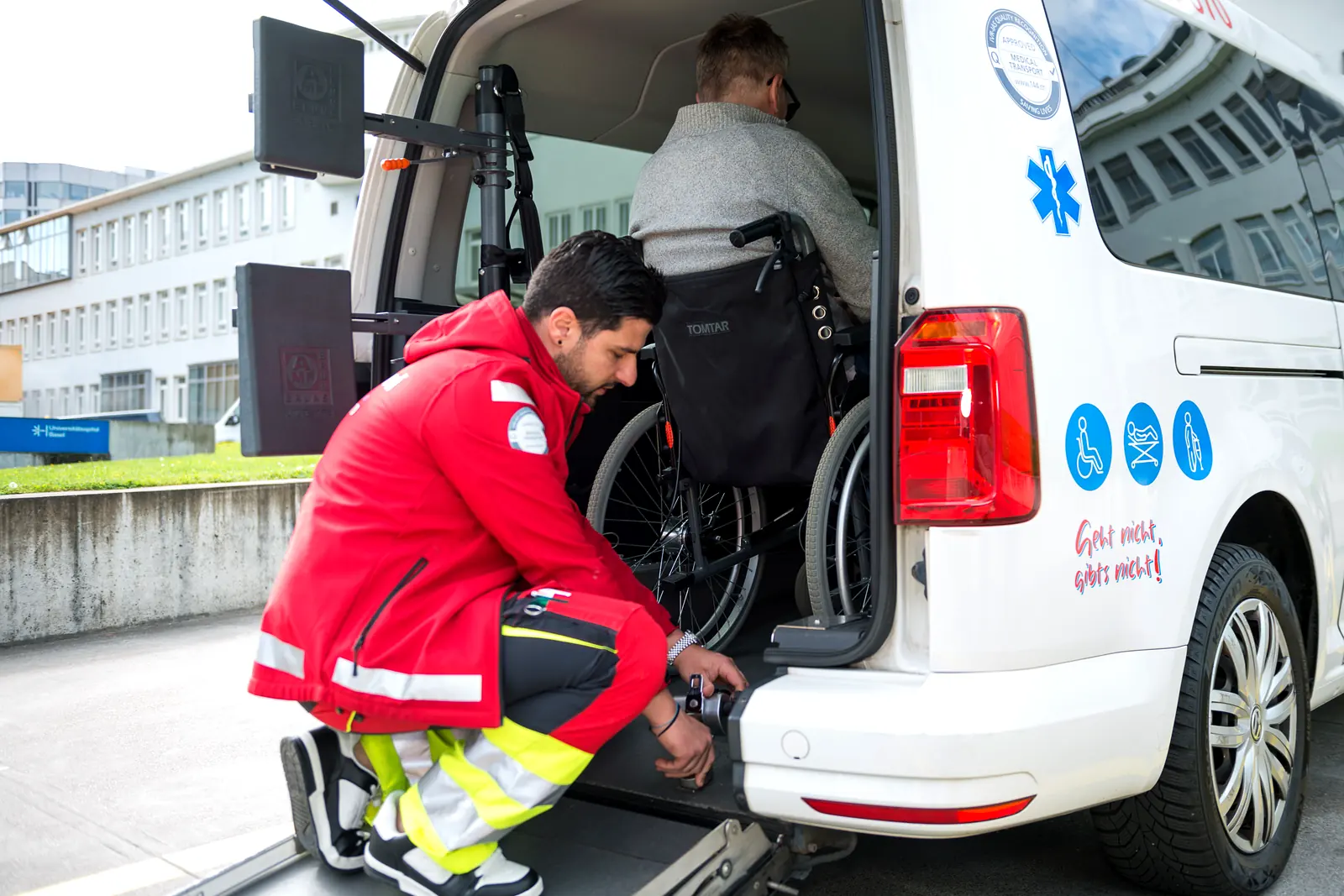
A wheelchair restraint system holds the wheelchair firmly to the vehicle floor during the journey. With the four-point system, the wheelchair is anchored at four points with straps; the person in it is also secured with their own belt. This means you can stay seated in your own wheelchair and still travel safely.
Also called: Four-point restraint system · Wheelchair tie-down · Wheelchair securement system · Wheelchair anchoring
Rails are set into the floor of the vehicle. Four straps are hooked into them and attached to sturdy points on the wheelchair frame — two at the front, two at the back. Once the straps are tightened, the wheelchair stands firm and cannot slide forwards, backwards or sideways.
The wheelchair on its own, however, does not protect the person in it. That is why they are additionally secured with an occupant belt, usually a lap belt and, depending on the vehicle, also a shoulder belt. The wheelchair and the person are thus secured separately — exactly as the seat belt does in a normal car seat.
Anyone who uses a wheelchair does not have to move into a car seat for a journey. Transferring is strenuous for many people and carries a risk of falling — especially after surgery, with paralysis or with severe weakness. With a restraint system, you stay in your familiar wheelchair, with your own seating position and your own cushion.
At Mobimed, wheelchairs are secured with an approved restraint system based on the four-point principle and a lap belt. This takes a few minutes — and it is the part of the journey where staff never cut corners.
Most standard wheelchairs can be secured with a four-point system. What matters are sturdy attachment points on the frame and brakes in good working order. Removable parts such as trays or bags are secured or stowed separately before the journey so that they do not fly around when braking.
With electric wheelchairs, weight and design are decisive. They are considerably heavier than folding wheelchairs; the vehicle and the ramp or lift must be designed for this. That is why Mobimed asks for the model and weight of electric wheelchairs in advance.
Anyone who is regularly transported in a wheelchair soon gets to know the routine. Even so, it is worth keeping an eye on a few things: does the lap belt sit low across the pelvis and not across the stomach? Are the wheelchair brakes on? Is there anything loose on the lap that could slide forward when braking?
If you are unsure, do not hesitate to ask the staff — they are happy to explain how the wheelchair is secured. Especially for people who cannot check their own position, it gives relatives peace of mind once they have seen and understood the securing process.
Thomas has used a wheelchair since an accident and works in a sheltered workshop in Basel. For his daily journey, the vehicle pulls up with its ramp in front of his house in Muttenz, he rolls in, and the wheelchair is anchored to the floor with four straps. The lap belt is added, and off they go. Thomas never has to transfer.
With wheelchair transport, the patient stays seated in their own wheelchair.
Learn more: Wheelchair transport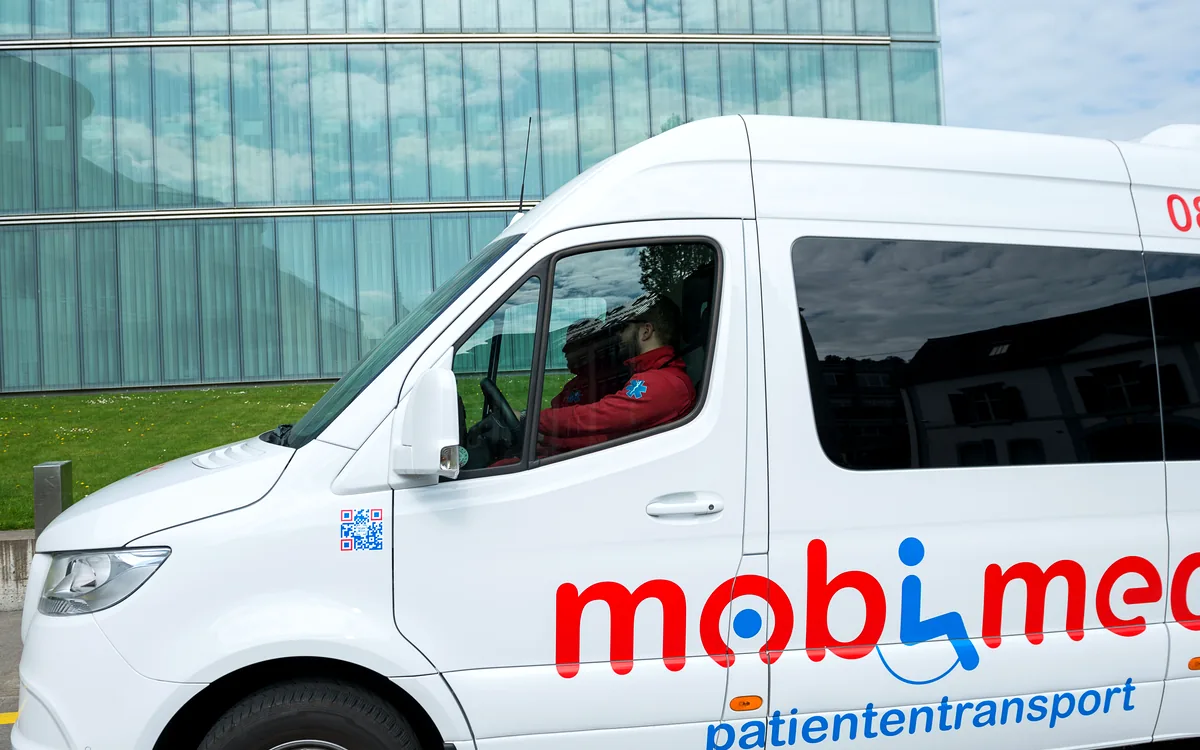
With our wheelchair transport service – often also called a wheelchair taxi – you stay seated in your own wheelchair: you enter the vehicle via a ramp or lift.
Learn more: Wheelchair taxi service Basel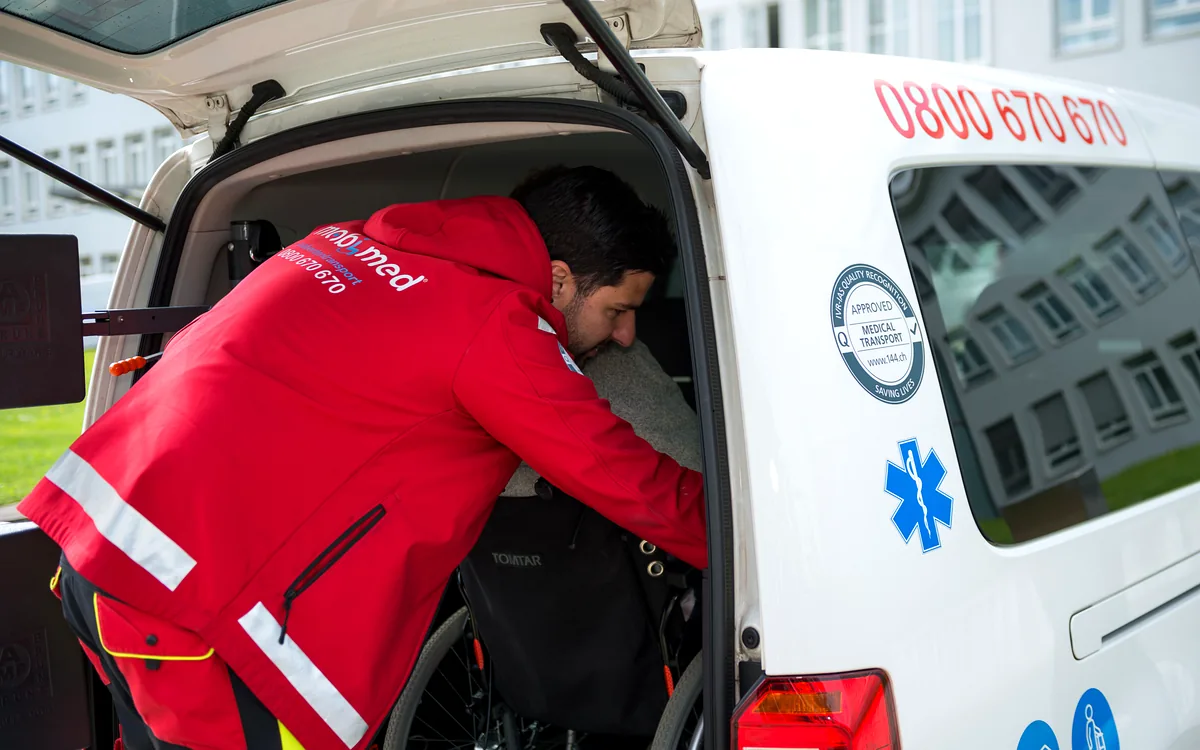
For us, transport for people with disabilities means accessible vehicles with a ramp or lift, trained staff and door-to-door assistance – for people with physical or multiple disabilities.
Learn more: Transport for people with disabilitiesIf the wheelchair is anchored with an approved restraint system and the person is secured with their own belt, the journey is designed for safety. What matters is that both are fitted correctly — and the staff are trained to do exactly that.
For standard folding wheelchairs, it is enough to state “in my own wheelchair” when booking. For electric wheelchairs or special models, we need the model and weight so that the right vehicle is sent.
Client, patient, appointment — one form that goes directly to our dispatch team. Prefer to call? That works too.
Recognition by the Swiss Interassociation for Rescue Services (IVR/IAS) is not a self-assessment but the result of an external audit of vehicles, equipment, training and procedures. Mobimed was the first patient transport provider in north-western Switzerland to receive it — and still holds it today.
Check the certificate in the IVR register