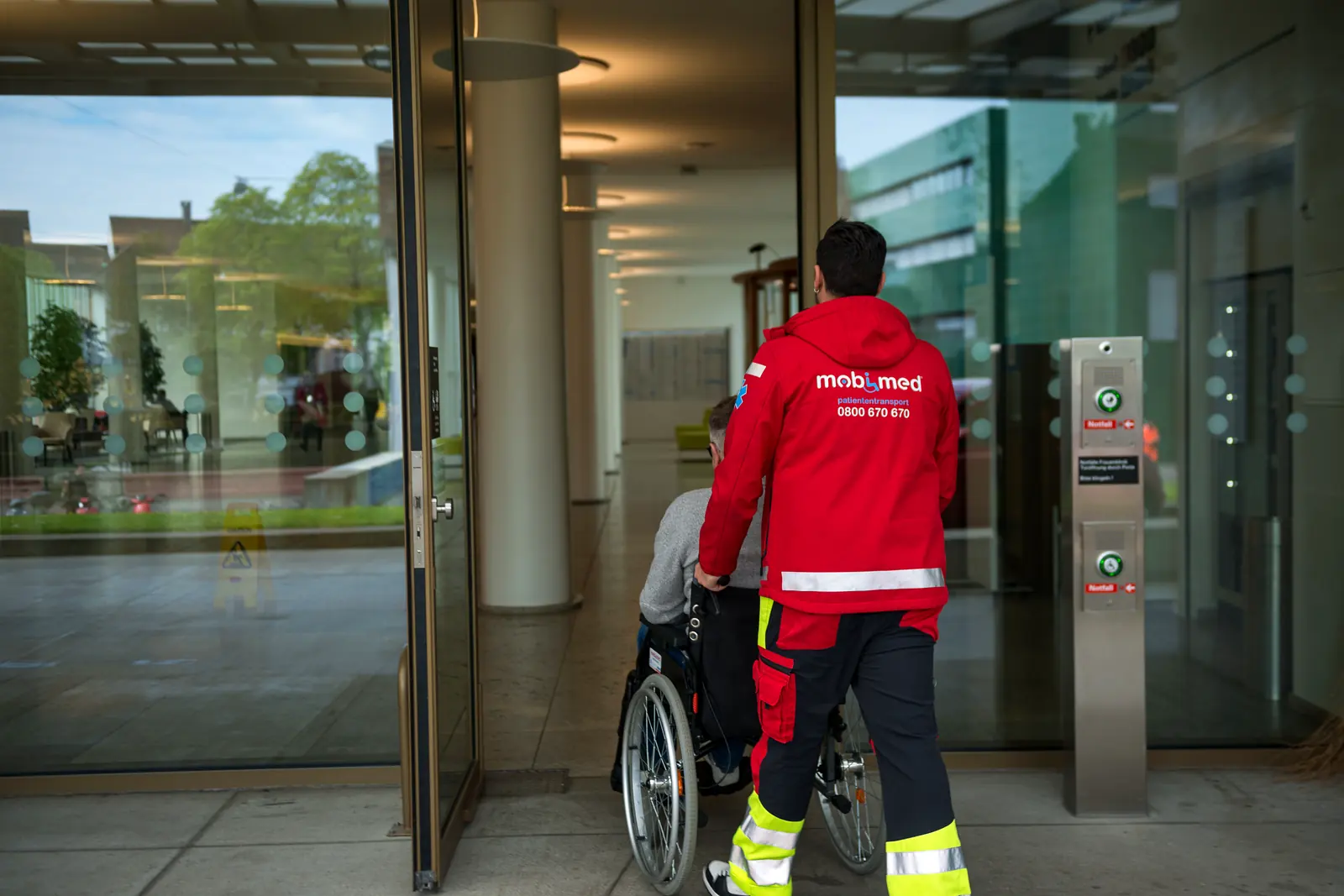
Seated transport
Seated transport is the right choice for medically stable patients who can sit during the journey but need support getting in and out.
Learn more: Seated transport
Glossary · Types of transport · also: carry chair, evacuation chair, stair transport
A stair chair is a light, padded chair with straps and carrying handles that is used to carry patients safely up and down stairs. It is used when a building has no lift or the stairwell is too narrow for a stretcher or wheelchair, and it is always handled by two trained people.
Also called: carry chair · evacuation chair · stair transport · stair chair transport
Basel has many older buildings without a lift, with narrow stairwells and tight corners. For people who can no longer climb stairs safely, their own flat becomes an obstacle — when going into hospital, to a doctor’s appointment or when returning home after an operation. The stair chair solves exactly this problem: it is narrow, manoeuvrable and built for use on stairs.
A stretcher often cannot be turned in narrow stairwells, and a wheelchair cannot be carried safely over stairs. The stair chair is designed for exactly that.
The person sits down in the stair chair in their flat and is secured with straps. Two staff members carry the chair — one above, one below — down step by step. Some models have tracks that glide over the edges of the steps and take the weight. At the bottom, the patient moves onto the stretcher, into the wheelchair or straight into the vehicle.
What matters is the teamwork between the two carriers: calm, announced movements and a secure hold give the person confidence. That is why at Mobimed the stair chair is never handled by one person alone.
When booking, tell us which floor the flat is on, whether there is a lift and how narrow the stairwell is. The approximate body weight also helps with planning. Then we arrive with the right equipment and enough staff. The stair chair can be combined with any type of transport — seated, in a wheelchair or lying down.
In addition to the classic stair chair, there are electric stair climbers that move step by step on their own. They are particularly suitable for regular journeys in the same building. A permanently installed stairlift is a solution for everyday life, but it requires planning, a permit and time.
For the interim period — for example after an operation, until the stairs are manageable again or the stairlift has been installed — stair chair transport is the simplest solution. It needs no installation and can be used flexibly on every journey.
Incidentally, the stair chair is used not only in residential buildings but also in older medical practice buildings, holiday flats or anywhere there are a few steps between the entrance and the lift. Even a few steps can be insurmountable for a weakened patient — with the stair chair they are managed in seconds, without risk for patient or staff.
Lisbeth, 84, has lived on the fourth floor of an old building in the St. Johann district for 50 years. Since a fall, she can no longer manage the stairs. For her appointment at the geriatric medicine clinic, her son books a seated transport and notes “4th floor, no lift”. Two staff members carry Lisbeth down in the stair chair, drive her to the appointment and afterwards carry her back up again.
Seated transport is the right choice for medically stable patients who can sit during the journey but need support getting in and out.
Learn more: Seated transport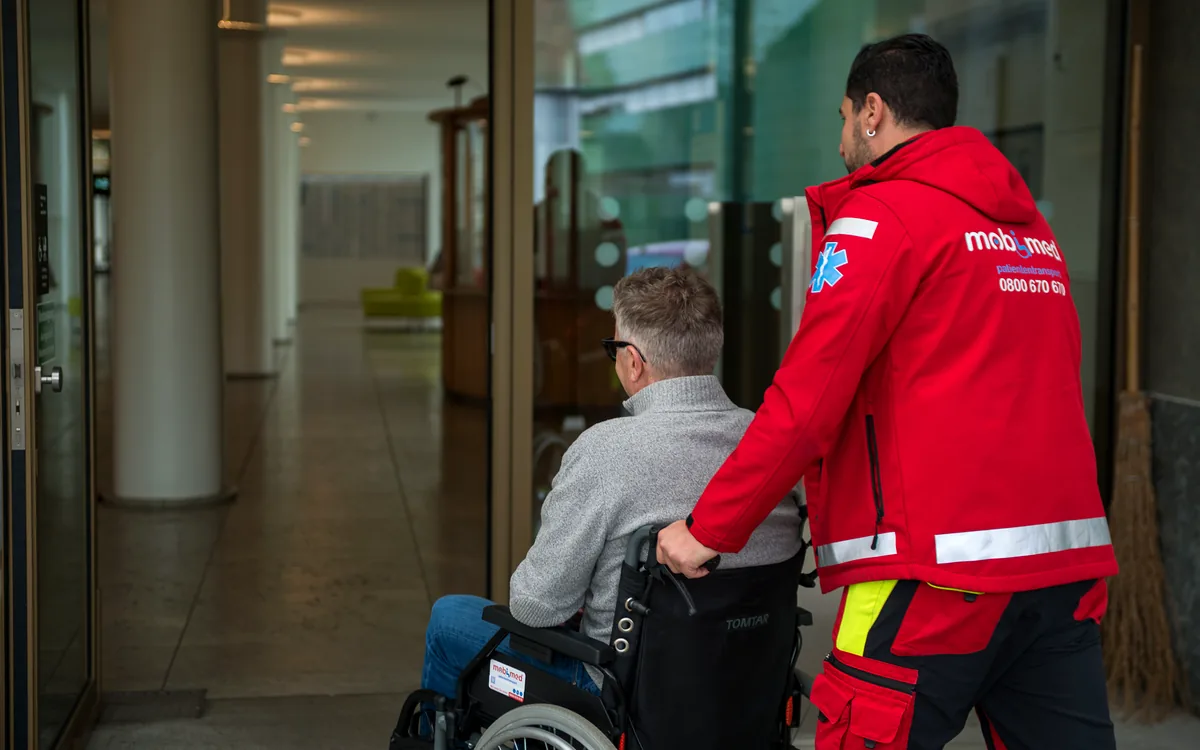
Our private transport service for seniors takes you to the doctor, to hospital, to therapy, to the hairdresser or to visit family – and back home again.
Learn more: Transport service for seniors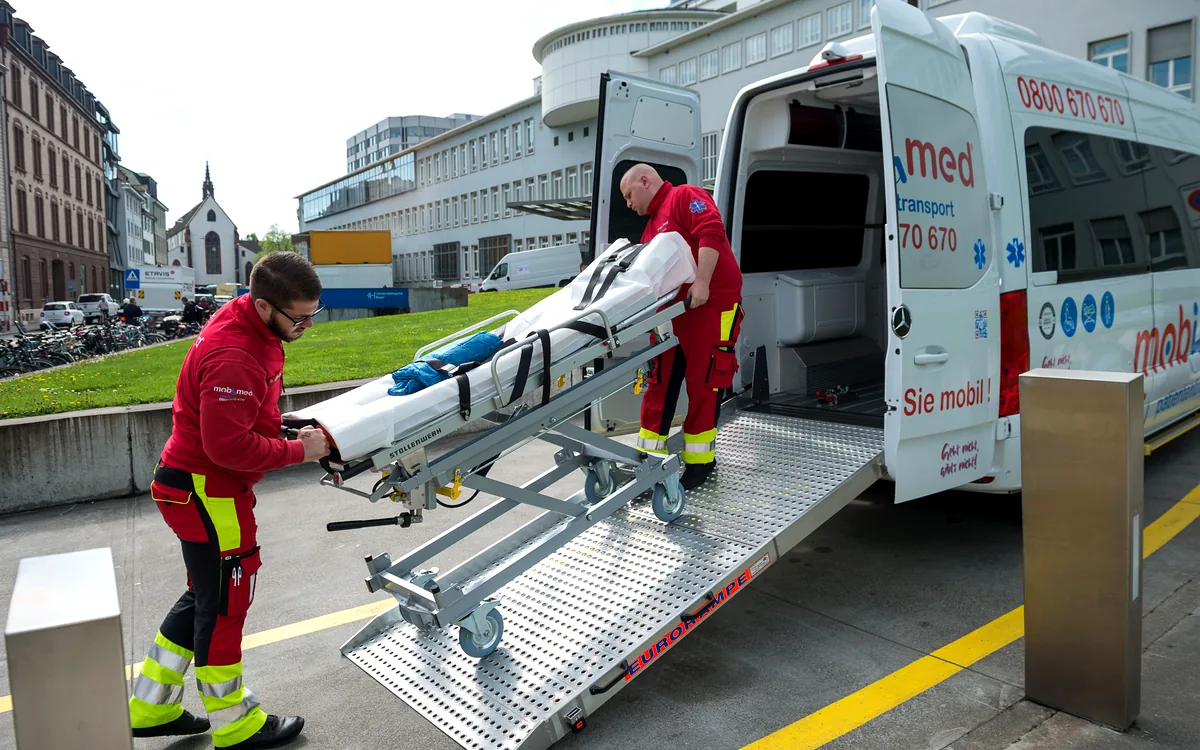
In a stretcher transport, the patient is carried on a patient stretcher in a vehicle specially equipped for the purpose.
Learn more: Stretcher transportYes, if it is carried out by two trained people. The person is secured with straps, and the carriers coordinate every step.
The effort for the stair chair and the second person is included in the price. You can get exact information before booking on 0800 670 670 (free call).
Client, patient, appointment — one form that goes directly to our dispatch team. Prefer to call? That works too.
Recognition by the Swiss Interassociation for Rescue Services (IVR/IAS) is not a self-assessment but the result of an external audit of vehicles, equipment, training and procedures. Mobimed was the first patient transport provider in north-western Switzerland to receive it — and still holds it today.
Check the certificate in the IVR register